

A Long Education in the Same Direction
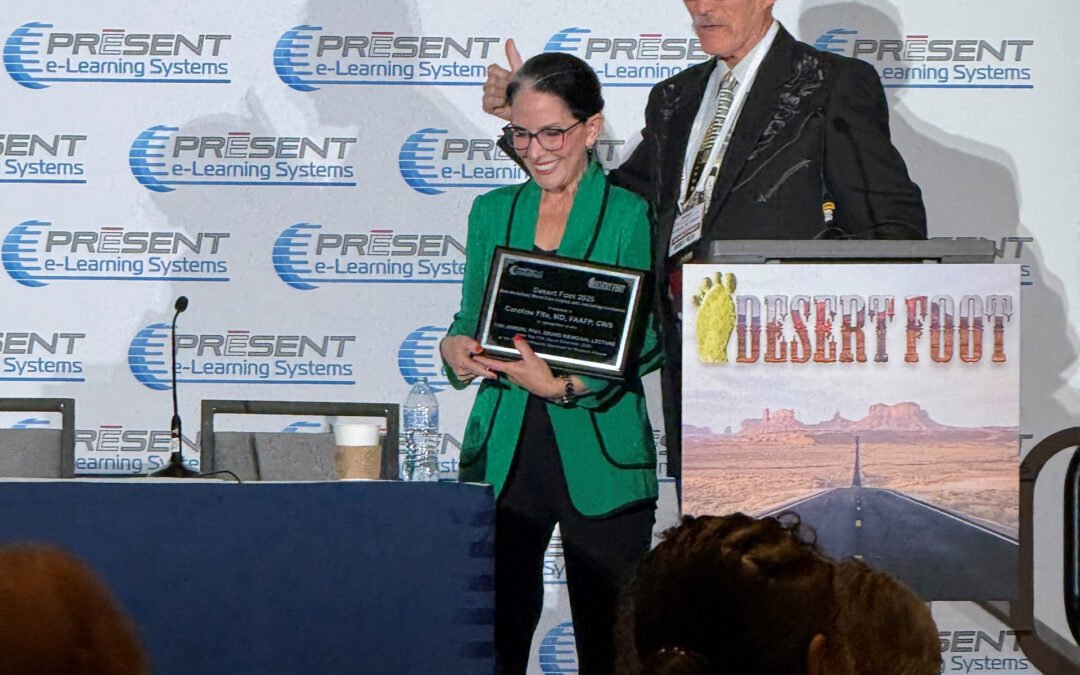
Last week at the Desert Foot meeting, I had the extraordinary honor of being the 13th recipient of the Paul Brand Award from Dr. Robert Frykberg, who began the tradition. It is a tremendous honor. Dr. Frykberg asked me to talk about the journey toward data-driven wound care, which I would call a long education in the same direction.
Dr. Paul Brand was a brilliant researcher, orthopedic surgeon and missionary physician as well as a mesmerizing speaker. His insights into the mechanism of neuropathy in leprosy were foundational to modern wound care and limb salvage. His journey to understand Hanson’s Disease began by asking simple questions, one of which was: “Why did the paralysis of leprosy patients follow a predictable pattern?” The answer came in a moment of literal enlightenment. He had worked all night by the light of an oil lamp performing an autopsy on the ulnar nerve of a leprosy patient, noting with surprise that only discrete areas of the nerve were affected by Mycobacterium leprae. Weary from a long night, he sat down outside the primitive hut in which he had been working when a ray of morning sunlight illuminated the arm through the open door. For the first time he was able to visualize the entire dissection – and that’s when he saw it. The organism had impacted only the sections of the nerve nearest the skin such as at the elbow. This was the explanation of the characteristic “claw hand” deformity of lepers and other characteristic features. The proliferation of M leprae is inhibited by temperatures higher than 37 C, thus the nerves are only vulnerable near the skin. It was Brand who showed that the neuropathic tissue itself was not diseased but was being repeatedly damaged because the body had lost what he called, “The Gift of Pain.”
My journey of understanding was far less dramatic. In 1990. I was happily ensconced on the faculty of the University of Texas Health Science Center in Houston, running the hyperbaric medicine program at Hermann Hospital in the Houston Medical Center, and doing decompression sickness research. I was annoyed by the constant referrals for venous leg ulcers (VLUs) and non-healing surgical wounds. I complained to my chairman that “someone should start a wound center,” and his answer was, “That would be you.” He was unmoved by my protestations of genuine ignorance. He also told me that the point of academic medicine was to see every patient encounter as an opportunity for data-driven clinical insights. That advice launched my career.
I began the wound center at Memorial Hermann in 1991 with only a 3-page handout given to me by Dr. Claude Burton during my fellowship at Duke on how to apply the “Duke Boot” for VLUs (an Unna’s boot over DuoDerm). However, this simple treatment healed 85% of the hundreds of VLUs I treated – with the exception of some patients with diabetes and rheumatoid arthritis. I wondered if the problem was hypoxia from ischemia, so I began measuring tissue oxygen levels with transcutaneous oximetry to identify patients who needed revascularization. Unfortunately, many patients never fully recovered from the massive surgical insult of lower extremity bypass surgery which was the standard of care for revascularization. In 1993, my cardiology colleagues told me about a new endovascular approach. The vascular surgeons, upset at losing the surgical referrals, predicted it would increase amputation rates, so we followed patients methodically. We demonstrated that the change in tissue oximetry predicted whether a diabetic foot ulcer healed after endovascular revascularization. By 1996 I was screening all lower extremity wounds with either TCOM or skin perfusion pressure on first clinic visit, prioritizing endovascular revascularization (usually within 72 hours), and using hyperbaric oxygen therapy only for those in whom tissue oximetry values remained insufficient. Today it would be called a limb salvage clinic – but we thought it was just appropriate clinical care.
>
Then in 1996, the university administration threatened to dock the pay of every faculty member who did not correctly calculate their Evaluation and Management (E&M) codes. I read the 53 page document and realized that the instructions were so complex, even an expert could not reliably calculate it. But it looked like a long algebra word problem, so I worked with a programmer friend to develop software that could internally audit a structured chart and calculate the E&M for me and automate other types of paperwork I needed. That’s where the story would have ended for me, had I not met David Walker, a gifted programmer with a wound care background who had already created a wound and hyperbaric documentation program. We joined forces and by 1997, I had a fully functional electronic documentation system at the UT/Hermann Hospital with a computer in every room. Intellicure was officially born in 2000. That was the beginning of structured documentation in wound care and within 5 years, the data would help save hospital based outpatient departments (HOPDs) and outpatient negative pressure wound therapy.
By 1998, novel wound treatments were on the horizon. I was thrilled to participate in both the Regranex and Apligraf prospective clinical trials but was deeply frustrated that almost none of my patients could qualify because they were either too sick or their wounds were too severe. In 2008, Dr. Marissa Carter and I used Intellicure data to show every wound care RCTs in the previous decade had enrolled subjects healthier than the average person on the street, and that most real-world patients would have been excluded from every major prospective trial performed up to that date. Even more concerning was the fact that even in the early 2000’s, Medicare coverage policies for these novel treatments mirrored the exclusion criteria in the clinical trials. More than twenty years ago we knew that nongeneralizable RCTs lead to restrictive Medicare coverage policies, but since neither the FDA nor CMS were interested in real-world data, there was little we could do about it.
Dr. Carter and I saw something else. Using Intellicure data, we followed a cohort of 5240 patients with 7099 wounds over five years, calculating the cost of each wound type. We found individual patients in service for 5 years with outpatient costs in excess of $250,000 each. Extrapolating only the outpatient wound center costs, we predicted that Medicare spending on these patients could exceed $20 Billion. That prediction turned out to be incredibly accurate when we were eventually able to analyze Medicare costs.
In 2005, those escalating Medicare costs caught the attention of CMS, but a MedCAC panel was unable to determine whether the usual wound care treatments were of any benefit to Medicare beneficiaries. The panel concluded that what was needed were large comparative databases to evaluate the value of our treatments and “go beyond the limitations of clinical trials… and… understand what happens in the real world.” Our tiny 5 year old company was the only source of structured data on chronic wounds. The entire chart of each patient was transmitted electronically, allowing us to create a registry which required no secondary data entry. We could then de-identify the aggregate data and use it for research. That year, data from Intellicure probably saved hospital-based outpatient wound care because CMS proposed basing hospital facility payment on 3 arbitrarily selected wound size categories. The Alliance of Wound Care Stakeholders presented Intellicure data to prove that wound size could not work as a way to differentiate the complexity of different levels of service, because most chronic wounds were relatively small, and this would mean that 99% of visits would be billed at the lowest level of service. We presented an alternative billing algorithm based on staff work which we had validated inside the Intellicure EHR and that may have prevented the closure of HOPDs.
In 2007 Intellicure’s wound registry data helped save the home use of NPWT. The FDA withheld clearance of a new device until KCI demonstrated that VAC therapy was as safe as moist wound care in the outpatient setting. Our real-world data was able to show the FDA that 200 patients on Coumadin had safely undergone NPWT at home and that overall, outpatients treated with NPWT had fewer adverse events than patients receiving moist wound care. When some regional Medicare carriers suggested that patients with VLUs should be able to perform compression bandaging on themselves (rather than paying for compression bandaging) Intellicure analyzed the records of 7251 patients from 29 wound care facilities and determined that 55% of VLU patients could not dress their lower bodies unaided. Medicare continued to pay for compression bandaging.
Real-world data also uncovered shocking gaps in standard care. In 2010 we showed that only 17% of VLU visits received adequate compression, and fewer than 6% of DFUs received total-contact casting – without which, the cost of care nearly doubled. Sadly, 2024 data show that there has been almost no improvement in either of those quality metrics despite our success in getting CMS to endorse wound care relevant quality measures.
In 2022, Intellicure data revealed something even more unsettling: honest healing rates were nowhere near the 90%+ numbers that most wound centers claimed on their websites. Across the U.S. Wound Registry (USWR), actual healing rates averaged around 35%–50%. Reporting “fantasy healing rates” was exactly the opposite of the approach needed to justify multibillion dollar Medicare expenditures for non-healing wounds Publicly Reported Wound Healing Rates: The Fantasy and the Reality – PubMed. There is a reason for reporting inflated healing rates. If wound outcomes were honestly reported, clinicians treating the most complicated cases would appear to have worse outcomes than their peers since, unlike oncology, there was no way to represent the complexity or severity of wound care patients. Working with Susan Horn, we developed the Wound Healing Index (WHI) – a series of risk models for various wound types which could enable us to report honest healing rates to CMS and create better matched controls for real world clinical trials. The WHI confirmed that most subjects in prospective trials would have healed without an advanced intervention if the trial had only run a little longer. In other words, until recently, most RCTs have been designed as “speed races” between groups of patients likely to heal anyway. More generalizable trials have been carried out in the past two years, and we should find a way to recognize those trials and make sure that the payers understand their importance to the development of coverage policy.
Chronic wound patients are extraordinarily sick. They have an average of eight serious comorbid conditions and take an average of 12 medications. Recently, under the aegis of the Wound Care Collaborative Community (WCCC), analysis of over 20,000 DFU and VLU patients shows that the patients share a common phenotype, with high prevalence rates of obesity, heart disease, diabetes and autoimmune disease. More than 40% develop a new ulcer while still being treated for the first one; and over 80% present with multiple ulcers of different types. Furthermore, about 7% of DFU patients die while in treatment for their DFU (in less than 7 months) (manuscript in process). We are clearly not managing the underlying cardiovascular disease of which their wounds are a symptom.
Here is where my data journey has brought me:
- The wound “types” we recognize may be artificial.
- Wounds are a symptom of disease.
- Current wound treatments do not change the risk factors for wound development.
- Current wound treatments don’t reliably overcome the barrier(s) to healing.
- We are not treating the underlying cause(s) of chronic wounds.
- The underlying reason(s) for chronic wounds may be systemic.
If the cause of chronic wounds is systemic, we may be wasting billions of dollars a year on better wound treatments when what we need are better patient treatments. If that is true, we will have to change everything about how we treat patients with chronic wounds. It will mean engaging in the Herculean task of lifestyle and disease management, rather than wound management. But, that may not be as difficult as changing our own behavior. We would have to become more like Dr. Paul Brand, who was less interested in treating the disease of leprosy than in caring for the people who suffered from it.
–Caroline
Dr. Fife is a world renowned wound care physician dedicated to improving patient outcomes through quality driven care. Please visit my blog at CarolineFifeMD.com and my Youtube channel at https://www.youtube.com/c/carolinefifemd/videos
The opinions, comments, and content expressed or implied in my statements are solely my own and do not necessarily reflect the position or views of Intellicure or any of the boards on which I serve.

Congratulation Dr. Fife on your award and all your contributions ! I found this post fascinating and valuable. I agree with you that wound products research excludes far too many real world patients and that WCC often show higher healing rates by simply excluding the patients who are moved to “palliative care”.
I also believe that Dr. Wolcott’s “Biofilm Based Wound Care” utilizing multiple strategies including DNA guided topical antibiotics has not been accepted by the WC providers and will prove to be one of the most effective strategies.
You have done fabulous wound care work and research over the years. You richly deserve the Paul Brand award!
Thanks especially for care and help that you have given for 10+ years to my husband, John “Jack” Olsen. Your recommendations have kept him alive and kicking years longer than his current physicians expected.
Best wishes for your current endeavors!
Sincerely,
Annette Sonnier Olsen