

Caroline E. Fife, MD Mary Ellen McEvoy, RN, MSN, MPH The lymphatic system is sometimes called the “other” circulatory system. Like the blood vascular system, it consists of a network of vessels which move fluid, and it develops embryologically alongside the blood vascular system. However, the structure and function of the lymphatic system are uniquely different from the vascular system. Understanding this mysterious system is vital to understanding and treating cancer as well as many chronic medical conditions. Unlike the blood circulatory system, until recently there has been no method to visualize the lymphatic vessels in “real time,” which is the main reason that much less is understood about it. The lymphatic system “facilitates the host’s immune defense,”1 which means that it is involved in virtually every type of infectious or inflammatory process. In addition to being ground zero for the body’s immune surveillance and response, the lymphatics perform the vital role of maintaining the body’s fluid volume. It is integral to the absorption of fat soluble nutrients from the mesentery of the gut, and the lymphatics even play a part in regulating the cerebrospinal fluid volume. In the developed world, the most common reason for lymphatic disruption is trauma or cancer nodal staging. Far less commonly, individuals may have “primary” lymphatic dysfunction related to congenital and/or genetic factors. However, lymphatic imaging has blurred the lines between the old paradigm of “primary” vs. “secondary” lymphedema. Evidence is accumulating that some individuals have an underlying subclinical dysfunction of the lymphatic system which only becomes clinically apparent as a result of relatively minor injury, venous disease, and certain autoimmune diseases. There appear to be wide variations in “normal” baseline lymphatic function, and many cases of what is called “secondary” lymphedema may in fact be the clinical manifestation of a pre-existing but asymptomatic abnormality. Compared to our understanding of the role of the lymphatics in immune response, we understand very little about the role of the lymphatic system in the development and progression of many chronic diseases, which makes it an exciting medical frontier. Rapid advances in the treatment of vascular disease have been made possible, in large part, by advances in vascular imaging. Lymphatic imaging is now enabling us to understand and improve treatment options for the many diseases which involve aberrations in lymphatic function.
Basic Anatomy
The lymphatics act as the “drainage and filtering system” for the body. The capillaries which carry blood to the tissues are intentionally designed to be somewhat leaky, keeping blood cells inside the vessels but allowing some fluid to leak out to bathe the interstitial space. This fluid is then reabsorbed by the lymphatics which function somewhat like a vacuum system that is always in the “on” position. The lymphatic system is “unidirectional”, meaning lymphatic fluid is intended to flow from the skin and various organs toward the thoracic duct where lymphatic fluid is then recycled into the blood circulatory system. The lymphatic network starts at the lymphatic capillary plexus under the dermis of the skin (and surrounding several organs). Here, particles, cells and interstitial fluid from blood capillary filtration enter the lymphatic system. The fluid pressure distends the endothelial cells which line the lymphatics, allowing fluid and matter from the extracellular spaces to enter the lymphatics. The colorless lymph fluid begins its journey, transported through deeper collection vessels where smooth muscle contractions rhythmically move the fluid to regional lymph nodes. It is important to know that the movement of lymphatic fluid from the face and neck is largely passive and dependent on gravity. However, below the clavicles, lymphatic fluid transport is designed to actively pump against gravity. This has profound implications for humans exposed to the microgravity of space travel. The regional lymph nodes are where immune surveillance and initial immune response occurs. Eventually, lymphatic fluid is propelled to the thoracic duct and into the left subclavian vein where the fluid returns to the blood circulation. This highly efficient recycling system is how the overall fluid volume of the circulatory system is maintained. It is now understood that capillary filtrate is primarily returned through lymphatics and not through venules.2,3 The lymphatic system thus cleanses and returns to the circulatory system about six liters of fluid per day which is an astounding volume.

The Extremities
Regional lymph anatomy is especially important to understand when considering cancer diagnoses and/or treatments that often result in lymphedema. The dorsal aspect of the hand (the “back” of the hand) drains lymph to the dorsal and volar (“inside”) aspect of the wrist. This fluid then makes its way to the medial bundles of the posterior and anterior arm and then on to the axillary lymph nodes and infraclavicular lymph nodes. Thus, lymphatic fluid from the hand drains to the wrist, the elbow, up the arm to the axilla and then to the chest. The medial lymphatics that drain the breast also empty into the axillary and infraclavicular lymph nodes, as well as the intermammary lymph nodes between the breasts.

Figure 2:3 Typical NIRF-LI images of normal lymphatics in the upper and lower extremities including the (a) dorsum of the hand, (b) dorsal and (c) volar forearms, (d) medial arm, (e) axillary nodes
The foot drains to the dorsal (“top) aspect of the foot to the superficial lateral bundles that accompany the saphenous veins of the medial leg, and up to the posterior and peroneal lymphatics of the back of the knee before draining into the inguinal lymph nodes at the groin. Breast cancer survivors often develop lymphedema, and so can men after pelvic radiation for prostate cancer. Lymphatic fluid will generally begin to accumulate distal to the damaged lymphatics.

Figure 3:3 (f) dorsum of the feet, (g) medial ankle, (h) medial calf and knee, and (i) inguinal basin.
Cranial & Cervical Lymphatics
There is an extensive network of lymphatics draining the head. It is also thought that this network assists in the clearance of cerebrospinal fluid. The oral cavity inside the mouth, the face, and lateral and posterior neck drain into the superficial or “external” lymphatics then to the supraclavicular (“above the clavicle”) lymph nodes. The ipsilateral (meaning, “on the same side of the body”) lympho-jugular lymphatic chain also drains into the supraclavicular lymph nodes as well as into the cervical lymph nodes of the neck. The mucosal lymphatics of the throat (“internal”) drain near the jugular vein. Up to 75% of head and neck cancer survivors are thought to experience lymphedema.

Figure 4:3 Typical NIRF-LI images of the lympho-jugular lymphatics draining to the (a) cervical and (b) supraclavicular lymph nodes following the injection of contrast agent into the palatine tonsils and (c) the external lymphatics draining to the supraclavicular lymph nodes following facial intradermal injections (adapted from [29], Rasmussen, JC, et al. 2018).
Anatomical Considerations That Impact Imaging
There are four different routes through which imaging agents could be introduced: (1) intradermal to be absorbed by the lymph plexus, (2) subcutaneous to permeate into lymph capillaries and vessels, (3) directly introducing agents into the lymphatic space through lymphatic vessel cannulation, and (4) IV for transit from the vascular space to the interstitium for direct deposition via microcirculation within the lymph nodes.2 Particles less than a few nanometers (~11 nm) can move into the lymph nodes via circulation or can diffuse into the lymphatic system at the gap junctions due to the hydrostatic pressure gradient. Particles as large 100 nm in diameter extravasate into the interstitial space and are phagocytosed by macrophages before being transported to the lymph nodes. Particles larger than this get trapped in the interstitium.2 With NIRF-LI, IC-Green can be administered intradermally in microdoses for effective imaging. This will be discussed in more detail in upcoming articles.
The Case for Increasing Use of Lymphatic Imaging
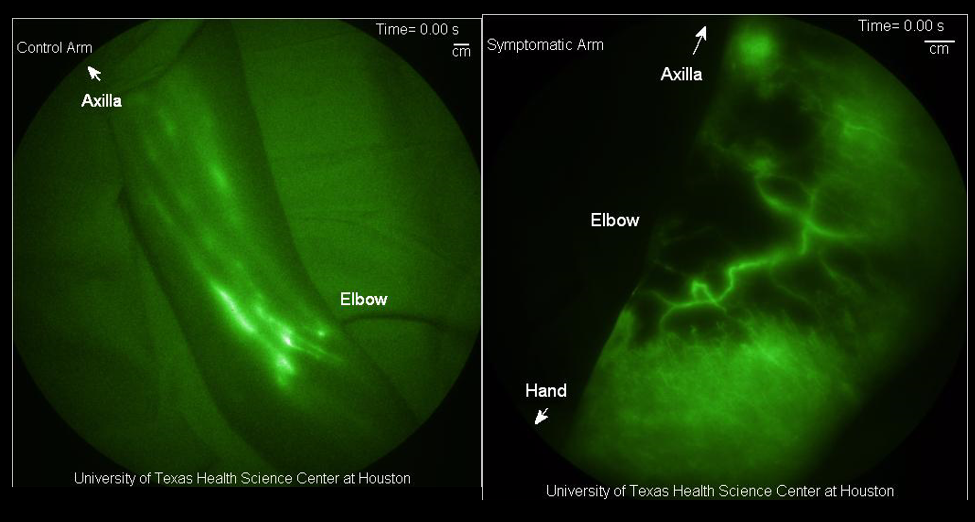
Much was known about basic lymphatic anatomy thanks to anatomical dissection but little was known about the way that the lymph vessels actually work to transmit fluid until the advent of real-time lymphatic imaging. NIRF imaging has “debunked” a number of myths and misconceptions about lymphatic function which have far reaching medical implications. From NIRF imaging we have learned that the pulsatile flow of the lymphatics (controlled by the autonomic nervous system) is distinctly separate from the cardiac rhythm and rate, and even responds to distant external stimuli. For example, gently massaging the left arm will cause the right arm lymphatics to increase their propulsive frequency. Lymphatics do cross the body’s midline (which has important implications for cancer metastasis) and in some cases will regrow to cross scar tissue. The advent of lymphatic imaging has also created the ability to assess primary lymphedema as either an absence of lymphatic channels or a reduction in their ability to transport fluid. In spite of the challenges in imaging of the lymphatic system, important advances have been made using imaging techniques developed nearly two decades ago. Advances are especially promising with regards to use of imaging in cancer treatment and staging modalities, in understanding cancer metastasis, and in confirming the efficacy of current lymphedema treatment methods. There is also evidence that further lymphatic imaging studies can shed light on treatment options and the underlying pathology of such diseases as chronic venous disease and rheumatoid arthritis.3 Stay tuned for more information on lymphatic imaging technology with a special emphasis on what has been learned with the use of near-infrared fluorescence lymphatic imaging (NIRF-LI). Meanwhile, check out the videos below depicting the normal functioning lymphatic flow.5
- Liao S, von der Weid PY. Lymphatic system: An active pathway for immune protection. Seminars in Cell & Developmental Biology. 2015;38:83-89. doi:10.1016/j.semcdb.2014.11.012
- Sharma R, Wendt JA, Rasmussen JC, Adams KE, Marshall MV, Sevick-Muraca EM. New horizons for imaging lymphatic function. Annals of the New York Academy of Sciences. 2008;1131(1):13-36. doi:10.1196/annals.1413.002
- Aldrich MB, Rasmussen JC, Fife CE, Shaitelman SF, Sevick-Muraca EM. The development and treatment of lymphatic dysfunction in cancer patients and survivors. Cancers. 2020;12(8):2280. doi:10.3390/cancers12082280
- O’Donnell TF, Rasmussen JC, Sevick-Muraca EM. New diagnostic modalities in the evaluation of lymphedema. Journal of Vascular Surgery: Venous and Lymphatic Disorders. 2017;5(2):261-273. doi:10.1016/j.jvsv.2016.10.083
- Burrows PE, Gonzalez-Garay ML, Rasmussen JC, et al. Lymphatic abnormalities are associated with rasa1 gene mutations in mouse and man. Proceedings of the National Academy of Sciences. 2013;110(21):8621-8626. doi:10.1073/pnas.1222722110
Other Posts in the Series to Date:
The (Mostly) Complete Guide to Lymphatic Anatomy: A Free Synopsis of Everything We Know Now
Introduction: I have decided to post a series of articles to summarize more than two decades of work in lymphatic imaging.

Dr. Fife is a world renowned wound care physician dedicated to improving patient outcomes through quality driven care. Please visit my blog at CarolineFifeMD.com and my Youtube channel at https://www.youtube.com/c/carolinefifemd/videos
The opinions, comments, and content expressed or implied in my statements are solely my own and do not necessarily reflect the position or views of Intellicure or any of the boards on which I serve.

As a lymphedema therapist, I’m thrilled that there’s NIRF-LI to help diagnose and guide treatment for lymphedema patients. It’s truly a game changer. Yet, here in Tucson, Arizona my colleagues and I have been looking, unsuccessfully, for over a year for a physician who would make this available to our patients, and theirs.
Any ideas, guidance, suggestions, contacts?
I so appreciate this generous sharing of your work.